

Table of Contents
- How an Off Road Bumper Durability Test Actually Works
- Steel vs Aluminum Off Road Bumper: Which Holds Up
- Off Road Bumper Construction and Weld Quality
- Bumper Recovery Point Rating and Frame Loads
- Off Road Bumper Corrosion Resistance Over Time
- Front vs Rear Bumper Configurations and Vehicle-Specific Fitment
- Reading a Long-Term Review and Assessing Damage After Impact
- Truck Army Tech Tip
- Conclusion
- Frequently Asked Questions
Last Updated: October 21, 2026
How an Off Road Bumper Durability Test Actually Works
An off road bumper durability test is a repeatable procedure that measures how a bumper absorbs impact, holds its shape, and keeps its mounting points intact under controlled loads. A useful durability test answers three questions: what hit the bumper, where it hit, and what the mounting points did afterward.
Most "durability tests" you see online are one-off stunts. A truck backs into a rock, a driver films it, and the internet declares the bumper indestructible. That is not a test. It is a demo.
What a Repeatable Test Looks Like
A real test controls the variables. That means a fixed impact location, a known weight or speed, the same approach angle, and a documented inspection before and after.
A basic field version you can run yourself:
- Measure and photograph the bumper before any impact
- Mark a consistent strike point on the center and on each corner
- Apply a controlled load, such as a slow press against a fixed obstacle or a weighted swing
- Re-measure the same points and inspect welds, brackets, and frame mounts
- Record deflection, cracking, and any movement at the mounting bolts
The point is not to destroy the bumper. It is to see how it behaves when the load is repeatable.
What the Test Cannot Tell You
A single impact test cannot predict fatigue. Metal that survives one hit can still crack after years of vibration and flex. A test also cannot simulate every trail condition, and results on one truck do not transfer directly to another because weight, mounting geometry, and frame design differ.
Steel vs Aluminum Off Road Bumper: Which Holds Up
Steel and aluminum fail differently under impact, and that difference matters more than any single spec sheet number. Steel is dense and ductile: under a hard hit it yields, dents, and absorbs energy across a wide area before it tears.
The trade-off is easiest to see in a controlled comparison.
| Factor | Steel | Aluminum |
|---|---|---|
| Impact behavior | Yields and absorbs energy over a wide area | Dents locally, can crack at welds or bends |
| Weight | Heavier, adds front-end load | Lighter, easier on handling and fuel use |
| Corrosion | Needs coating upkeep; rusts at chips and seams | Resists rust but can corrode galvanically near steel fasteners |
| Repair | Weldable and straightenable by a shop | Harder to weld cleanly; often replaced rather than repaired |
| Best use | Rocky trails and expected contact | Weight-sensitive builds and light trail use |
Weight is not just a comfort issue. A heavier steel bumper sits farther forward of the front axle, which changes steering feel and can affect how the front suspension carries load. Check it against your truck's front axle rating and any leveling or spring changes.
A practical rule: if you run rocky trails and expect contact, steel's energy absorption and repairability are the safer bet.
Off Road Bumper Construction and Weld Quality
Weld quality decides whether a bumper survives real abuse. A bumper is only as strong as the joints that hold its plates and tubes together, and poor welds fail first under impact and vibration.
Look for consistent weld beads with no undercutting, spatter, or gaps. Check that gussets reinforce the corners where the most stress concentrates. A bumper with clean welds and proper bracing will outlast one built from thicker steel with sloppy joints.
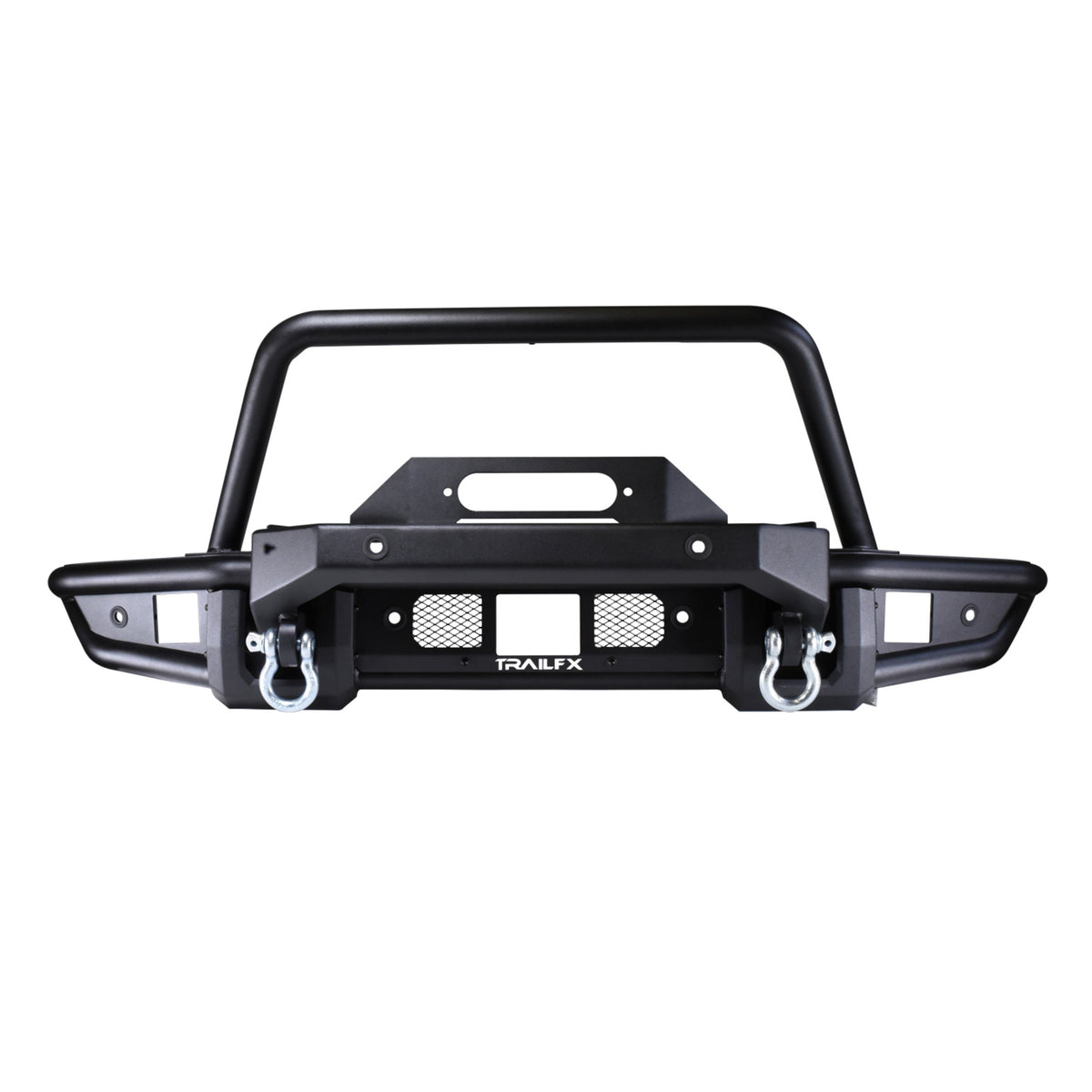
A good example to study is the TrailFX FPRB001TI steel front bumper for the 2016-2023 Toyota Tacoma. It is powder-coated steel, so you can look at how the plates meet and where the joints sit before you buy. Confirm fitment for your truck before ordering.

Plate Steel, Tubing, and DOM Tubing Compared
Plate steel is flat, thick material used for the main body and skid surfaces. It spreads impact across a wide area.
Standard tubing forms the rounded shapes on bull bars and brush guards. It looks rugged but wall thickness varies widely between products.
DOM tubing is drawn-over-mandrel tubing with consistent wall thickness and fewer seams, which makes it stronger and more predictable under load. It costs more, and for hard trail use it is worth it.
Bumper Recovery Point Rating and Frame Loads
A recovery point is only as strong as the weakest link in the chain that carries the load: the D-ring or shackle tab, the bumper shell it is welded to, the frame brackets, the mounting hardware, and the frame itself.
Impact loads and recovery loads are different animals. A trail impact is a short, sharp hit that the bumper shell and mounts absorb and spread across the frame horns.
How the bumper mounts decides how that load reaches the frame. Factory mounting points and properly engineered brackets spread force across multiple frame locations; universal clamps and single-bolt tabs concentrate it. Check for:
- Grade and size of mounting hardware, and whether it matches the frame's factory bolt pattern
- Bracket thickness and whether gussets tie the bracket back into the frame
- Whether the tab is welded to the shell only or braced through to the bracket
- Any stated recovery rating, and whether it is for a static pull or a dynamic (snatch) recovery
If a listing does not state a recovery rating, treat the tabs as tie-down points, not recovery anchors. Pulling beyond what the mounts and frame can handle can bend the frame horns or send hardware flying, and a bent frame is a far more expensive problem than a dented bumper.
Heavy-duty trucks see the biggest loads. The TrailFX FHDNW007TI front bumper for the 2020-2023 Silverado 2500 HD and 3500 HD is built with tow hook mounts, so check the listing for how they attach and what they are meant for. Confirm fitment for your truck before ordering.

This is also where off-road protection and road-crash safety part ways.
Off Road Bumper Corrosion Resistance Over Time
Corrosion is the slow killer that impact tests ignore. Road salt, mud, and moisture work on welds and seams long after the trail ends, and a bumper that survives impacts can still rot from the inside.
Powder coating over an e-coated surface offers better protection than powder coat alone. The e-coat reaches inside seams and corners where spray finishes miss. Watch the weld areas and the backside of the bumper, which collect debris and hold moisture.
A simple maintenance routine extends life:
- Rinse the underside and welds after salty or muddy drives
- Touch up chips before rust spreads
- Check mounting bolts for corrosion and torque
Front vs Rear Bumper Configurations and Vehicle-Specific Fitment
Front and rear bumpers serve different jobs, and fitment is never universal. Front bumpers carry winches, lights, and grille protection. Rear bumpers handle departure angle, tow compatibility, and tailgate access.
Fitment depends on year, make, model, trim, and configuration. A bumper listed for a model range may not fit every trim, and sensor compatibility varies. Always confirm the exact application before ordering.
Three Bumpers Built for Different Trucks
The Fishbone Offroad Steelhead Front Bumper (FB22359) for 2022+ Ford Bronco pairs steel construction with a black powder-coated finish for front-end protection and a trail-ready look. It is built for the current Bronco platform, so confirm fitment for your truck and configuration before ordering.

The TrailFX RPRB001TI Black Steel Rear Bumper for 2016-2023 Toyota Tacoma is a one-piece steel rear bumper with a black powder coat, no-drill installation, and included mounting hardware. It works with the OEM hitch configuration and includes light cutouts and a license plate mount. Confirm fitment for your truck before ordering.

The TrailFX FX3033A Front Replacement Bumper for 2024-2026 Chevrolet Silverado 2500 HD and 3500 HD uses heavy-duty diamond plate steel with an e-coated, gloss black powder-coated finish. It mounts at factory points without drilling and keeps original equipment sensors working. Confirm fitment for your truck before ordering.

Reading a Long-Term Review and Assessing Damage After Impact
A credible long-term review shows the bumper after months or years of use, not just on day one. Look for photos of welds, mounting points, and finish condition over time.
When assessing damage after an impact, check in order:
- Frame and mounting bolts for movement or bending
- Welds for cracks, especially at corners and gussets
- The bumper shell for dents that affect clearance or sensor function
- Coating for chips that invite corrosion
Truck Army Tech Tip
Before any trail run, torque-check your bumper mounting bolts and inspect the welds you can reach. Vibration loosens hardware over time, and a loose bolt concentrates stress on the remaining mounts. A five-minute check at home beats a trailside repair.
Conclusion
Picking a durable off road bumper comes down to matching construction, mounting, and material to how you actually drive. Steel and DOM tubing favor hard trail use, while aluminum favors weight savings and lighter duty. Fitment and recovery ratings deserve the same scrutiny as the bumper's looks.
Truck Army stocks vehicle-specific bumpers built for real trucks, including the Fishbone Offroad Steelhead and TrailFX options for the Bronco, Tacoma, and Silverado HD. Browse our bumper selection and match the right bumper to your year, make, model, and trim before you buy.
Frequently Asked Questions
What makes an off-road bumper durable?
Durability comes down to four things: the material and thickness of the steel or aluminum, how well the bumper is welded and braced, how it mounts to the frame, and how the finish holds up against rust. A thick bumper with poor welds or weak mounting points will fail before a thinner, well-built one. Ask about plate thickness, weld quality, mounting hardware, and coating before you buy.
Are steel or aluminum off-road bumpers more durable?
Steel generally wins on impact resistance and can be repaired after a hit, while aluminum saves weight and resists corrosion better in road-salt states. In a steel vs aluminum off-road bumper comparison, the right pick depends on your use: rocky trails and heavy recovery favor steel, while daily driving and fuel economy favor aluminum. Neither is universally stronger, so match the material to how you actually drive.
Do off-road bumpers need to be crash-tested?
Aftermarket bumpers are not required to pass the same crash tests as factory bumpers, and many are sold for off-road use only. Some products, like the TrailFX rear bumper for the 2016-2023 Tacoma, are stated as approved to applicable government safety standards, but that varies by product. Check the manufacturer's stated compliance and understand that a heavy steel bumper can change how your truck behaves in a collision.
What should I check after an off-road bumper takes an impact?
Inspect the welds at the mounting brackets first, since a bent bracket or cracked weld matters more than a cosmetic dent. Check that the bumper still sits level and that gaps to the body and grille are even. Look for cracked powder coat, which invites rust, and re-check any recovery points for deformation before you use them. If the frame horns or mounting hardware show damage, have a shop inspect it before driving hard again.
Does a heavier bumper always mean better durability?
No. Weight adds impact mass but also loads your front suspension, steering, and frame mounts, and it can hurt fuel economy and ride quality. A well-designed bumper uses plate steel and bracing where it counts rather than adding bulk everywhere. Look at construction and mounting rather than the shipping weight, and account for the extra pounds when you plan suspension or leveling upgrades.