
Last Updated: November 20, 2026
Quick Summary
The right truck toolbox depends on how you will use it. Start by measuring your bed at the bulkhead and wheel wells, then choose a style (crossover, side-mount, chest, or standard) and confirm fitment for your exact year, make, model and bed length. Decide on aluminum or steel and no-drill or drilled mounting based on your work and climate.
- Write down what you will store, how often you will open the box, and whether it must stay dry.
- Measure bed width at the bulkhead and at the wheel wells before shopping.
- Confirm fitment against the listing for your exact year, make, model, trim and bed length.
- Plan cover compatibility before buying, since a tall box can block a folding cover.
- Choose no-drill mounting for leased or moved trucks; drilled mounting for permanent heavy-duty use.
Table of Contents
- Start With How You Will Use the Toolbox
- Truck Toolbox Types: Crossover, Side-Mount, Chest, and Standard
- How to Measure Your Truck Bed for a Toolbox
- Best Truck Toolbox for Bed Cover Compatibility
- Aluminum vs Steel Truck Toolboxes
- Truck Toolbox Security Features to Check
- Booking Your Toolbox Fitment Check Before You Buy
- Frequently Asked Questions
Start With How You Will Use the Toolbox
Before you look at a single product, decide what the toolbox has to do. A contractor hauling wet hand tools, fasteners and a generator cord needs something very different from a weekend camper who wants a place to stash recovery straps. Get the use case right and most of the other decisions make themselves.
Write down three things: what you will store, how often you will open the box, and whether it has to stay dry in rain or road spray. A daily work truck demands a lock you can open with one hand, a lid that stays up in wind, and enough internal depth for bulky gear. A recreational truck can get by with a smaller box and a simpler latch.
Buyers who skip this step often end up with a box that holds the wrong things in the wrong place. Start here and the rest of this guide becomes a process of elimination.
Truck Toolbox Types: Crossover, Side-Mount, Chest, and Standard
Toolboxes fall into a few broad families, and each one trades space, access and visibility differently.
| Type | Where it mounts | Best for | Main trade-off |
|---|---|---|---|
| Crossover | Across the front of the bed, behind the cab | Keeping bed length usable for cargo | Can limit how far the tailgate and bed-length cargo reach |
| Side-mount | Along the side rail of the bed | Quick access and keeping the floor open | Narrows the bed and takes up side-rail space |
| Chest | Standalone box, often in the bed or on the bed floor | Organized, deep storage | Eats bed floor and can get in the way of loads |
| Standard | Full-width box in the bed | Maximum storage capacity | Shortens the usable bed and adds height |
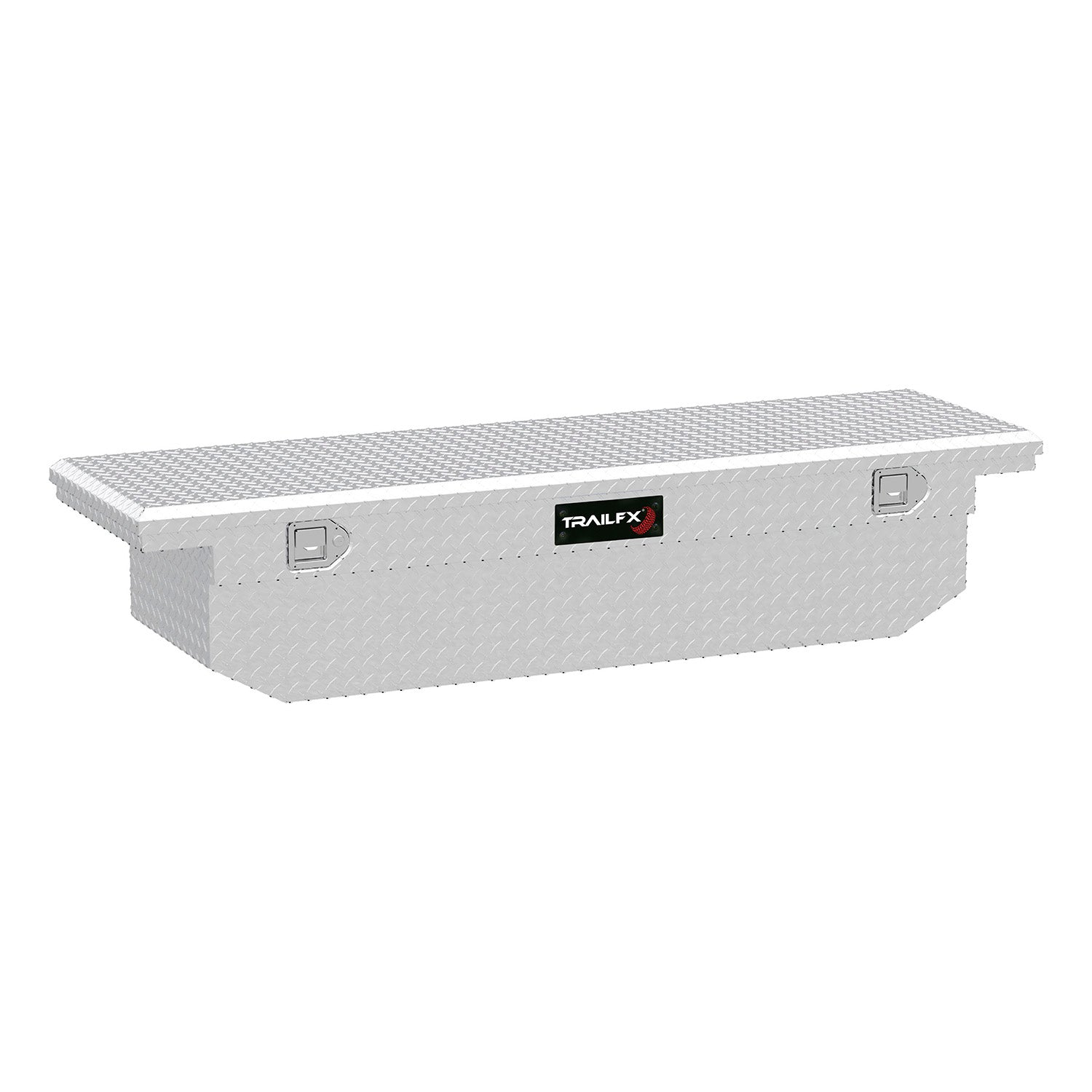
Crossover boxes are the most common choice for pickups. The TrailFX 120701 69-Inch Low-Profile Crossover Truck Tool Box with Tray, Polished Aluminum is a good example of the style: a low profile that keeps sightlines open, a lockable paddle handle, and an included tray for smaller items. Per its listing, it offers approximately 8.4 cubic feet of internal storage.
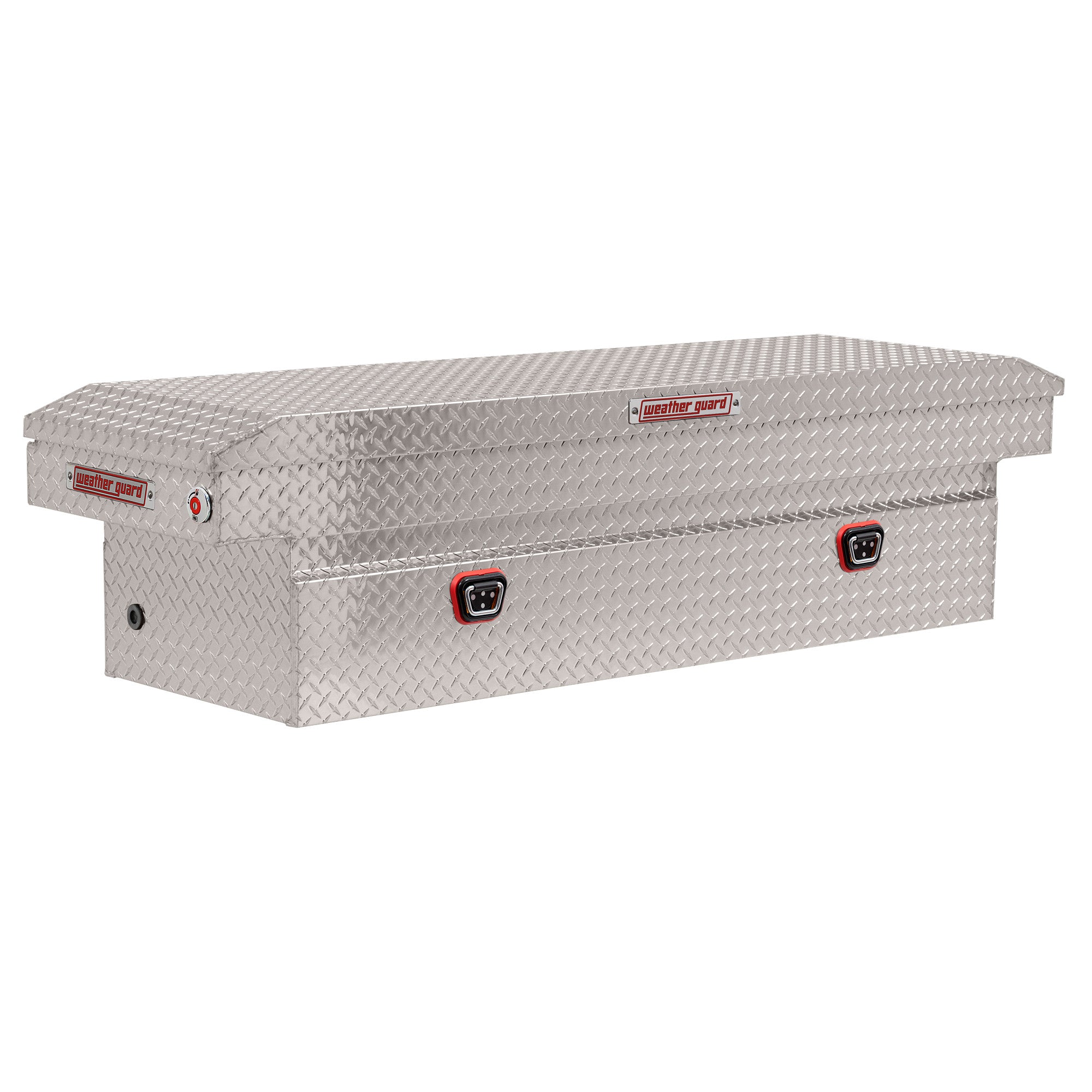
Side-mount and chest boxes make more sense when you need to keep the middle of the bed clear. For a more substantial full-width option, the Weather Guard 127-0-04 Crossover Truck Tool Box, Full-Size Standard Saddle Box, Clear Aluminum lists 11 cubic feet of storage and a limited lifetime warranty from the manufacturer.
Confirm fitment for your exact year, make, model and bed length before you buy. A box that fits one generation of a truck may not fit the next.
How to Measure Your Truck Bed for a Toolbox
Measuring your bed is the step most buyers rush, and it is the one that causes returns. Do it before you shop, write the numbers down, and compare them to the product listing rather than to a general size chart. A box that fits one bed length or trim level may not fit the next, so treat every measurement as specific to your exact year, make, model, cab, and bed length.
What to Measure and Where
Use a tape measure and take each reading at the point where the box will actually sit, not at the widest or narrowest point of the bed.
- Inside bed width at the bulkhead. Measure wall to wall at the front of the bed, where a crossover box mounts. This is usually narrower than the width at the wheel wells.
- Inside bed width at the wheel wells. Measure between the wheel-well humps. This tells you whether a full-width box will clear the wells or sit above them.
- Inside bed length. Measure from the bulkhead to the inside of the closed tailgate. Note how much of that length you need for cargo, because a crossover box consumes the front section.
- Bed rail height and rail profile. Measure from the bed floor to the top of the rail, and note whether the rail is flat, capped, or has factory accessory rails. Many boxes mount to the rail or the bed floor, and the profile decides which mounting hardware will work.
- Cab-to-bed clearance. Measure the gap between the back of the cab and the front of the bed. This limits how deep a crossover box can sit without contacting the cab.
- Lid swing clearance. With the box in place, the lid has to open fully. Check overhead clearance in your garage or parking structure and confirm the lid will not hit a rear window or cab roof.
How to Check Those Numbers Against a Listing
Once you have your measurements, read the listing the same way an installer would.
- Match the usable width, not the outside width. The TrailFX 120701 listing, for example, describes a bed with about 58 inches of usable width. Compare that to your bulkhead width, not your wheel-well width.
- Confirm the mounting method. The same listing notes that drilling may be required. If you are not willing to drill, that changes which boxes you should be shopping.
- Check the vehicle fitment list. Fitment varies by year, make, model, trim, cab, and bed length. Only trust fitment that appears in the listing for your exact configuration.
- Read the hardware list. Confirm the box ships with the brackets and fasteners needed for your rail style, and note whether any parts are sold separately.
- Check cover compatibility. If you run a tonneau or hard cover, confirm the cover manufacturer's clearance specs for your bed before you pair the two.
A Quick Fitment Checklist
- Bed width at the bulkhead and at the wheel wells
- Bed length and how much you need for cargo
- Rail height and rail profile
- Cab-to-bed clearance
- Lid swing and overhead clearance
- Mounting method (no-drill vs. drilled) and whether you are comfortable with it
- Cover compatibility, if applicable
- Fitment confirmed against the listing for your exact configuration
Watch out: if any measurement lands close to a listed limit, do not assume it will fit. Contact a Truck Army specialist before ordering.
Best Truck Toolbox for Bed Cover Compatibility
A toolbox and a bed cover have to work together, and the two most common conflicts are height and mounting. A tall standard box can prevent a folding cover from lying flat, and a box mounted too far back can block a hard cover's hinge path.
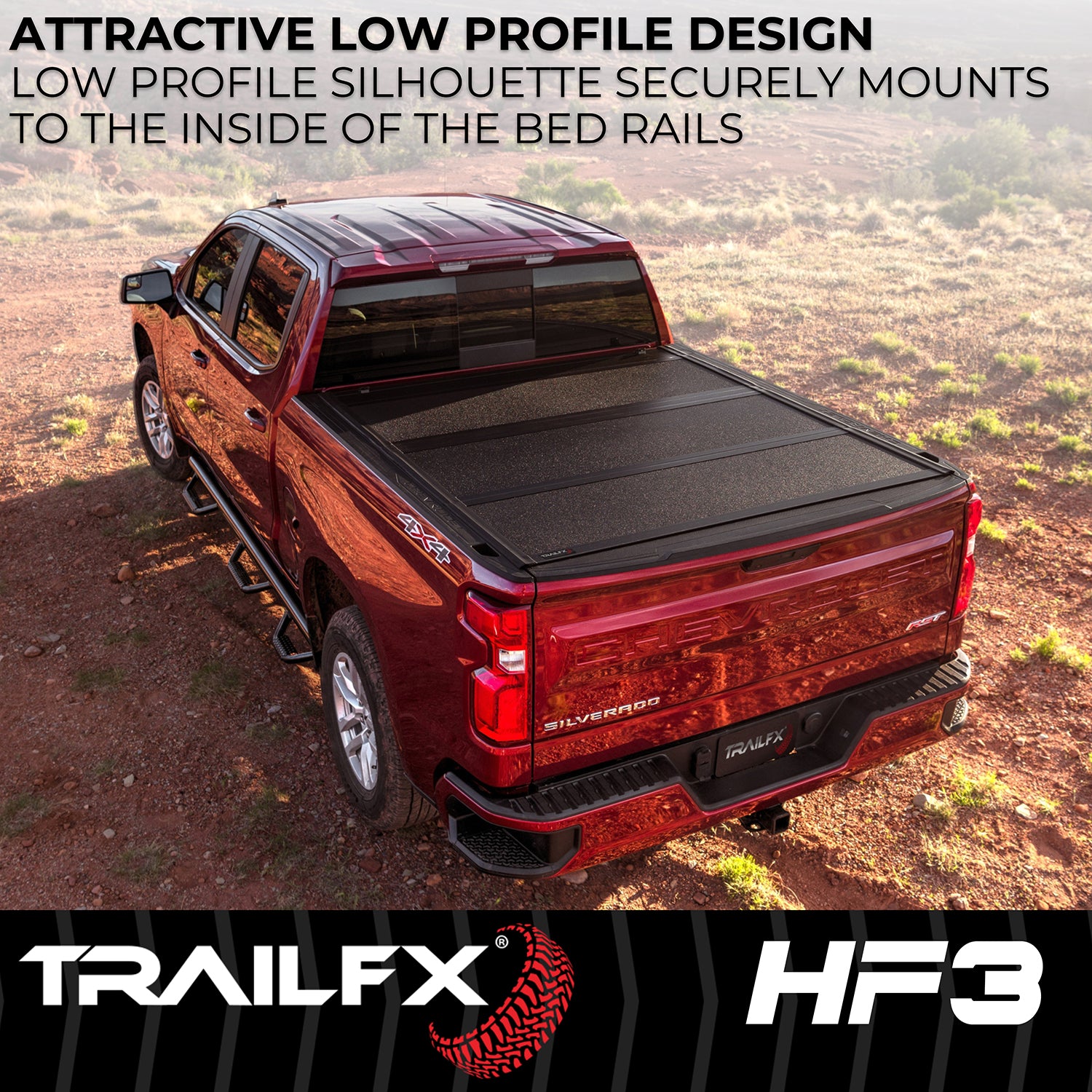
If you run a cover, look for a low-profile crossover box and confirm the cover manufacturer's clearance specs for your bed. The Trailfx HF3 Hard Folding Tonneau Cover TFX8007 is one option listed for select 2020 to 2022 Chevy Silverado and GMC Sierra HD trucks, so check that the listing matches your truck before you pair it with a box. A related Truck Army guide, Truck Tool Box Camo: Features and Fitment Guide, walks through how the two systems interact.
Plan the pairing before you buy either part. Ordering a box first and then discovering the cover won't clear is a frustrating and expensive mistake.
Aluminum vs Steel Truck Toolboxes
Aluminum and steel are the two materials you will see most often, and they make different trade-offs.
Aluminum is lighter, resists rust better and usually costs more. The TrailFX models above use a diamond-tread or powder-coated finish, per their listings.
Steel is heavier and generally less expensive, and it can be very strong. The trade-off is weight and rust risk if the coating is scratched and left exposed to road salt and moisture.
Pros and cons at a glance:
- Aluminum pros: lighter, corrosion resistant, clean appearance. Cons: higher price, can dent under heavy impact.
- Steel pros: lower cost, strong under load. Cons: heavier, rust risk if the finish is damaged.
Decide based on your work and your climate. A contractor in a wet, salted region may prefer aluminum. A rancher hauling heavy equipment on dry ground may find steel a reasonable value. Whichever you choose, check the listing for the material and finish details.
Truck Toolbox Security Features to Check
A toolbox is only useful if the contents stay put, and security comes down to two things: the lock and the mount. A great lock on a box that can be pried or lifted is not much protection, so evaluate both together.
Locks and Latches
Look closely at how the lid secures. Check whether it latches with a key or a push button, whether the lock can be keyed alike with other boxes on a fleet, and whether the latch sits in a protected position where it cannot be easily pried. For work trucks, a lock you can operate quickly with one hand matters. For recreational trucks, a sturdier lock and a box that is hard to pry open may matter more. Per its listing, the TrailFX 120693C is a no-drill option with a lockable compartment and an included tray for organizing smaller tools.
No-Drill vs. Drilled Mounting
How the box attaches affects security, stability, and how much commitment you are making to your bed.
| Mounting method | How it works | Trade-offs |
|---|---|---|
| No-drill / clamp-on | Brackets clamp to the bed rail or use existing mounting points | Easier to install and remove; depends on rail strength and clamp torque; can loosen over time if not checked |
| Drilled | Fasteners go through the bed rail or bed floor | More secure and stable under load; requires drilling and leaves holes if removed; needs rust protection at the holes |
No-drill mounting is the better fit for leased trucks, trucks that get traded in, or owners who want to move the box between vehicles. Drilled mounting is the better fit for a permanent work truck that carries heavy tools and sees rough roads, because the fasteners hold the box more rigidly.
Installation Difficulty and Tools
Crossover boxes of this size are generally easier to install with a helper. Plan on basic hand tools, a socket set, wrenches, and a torque wrench, plus a helper to set the box in place without scratching the bed rail. No-drill installs are typically quicker; drilled installs take longer because you have to measure, mark, drill, and treat the holes. If you are not comfortable drilling into your bed or torquing the hardware to spec, professional installation is a reasonable choice.
Load Stability and Tamper Resistance
Check how the box is mounted and whether the hardware is accessible. Bolt-on hardware that is reachable only from inside the bed is harder to tamper with than hardware that can be reached from outside. Also confirm the box is rated for the weight you plan to carry and that the mount distributes that load across the rail or floor rather than a single point.
Watch out: a clamp-on box that is not rechecked after the first few hundred miles can loosen. Check the hardware after the first week and again at each oil change.
Booking Your Toolbox Fitment Check Before You Buy
Even a careful measurement can miss something, so get a second set of eyes on your truck before you commit. Truck Army's specialists can help answer fitment and installation questions before you place an order.
Use the vehicle fitment tool to check your exact truck, and reach out to a specialist if your setup is unusual, you are running a cover, or you are unsure whether drilling is acceptable. A short conversation now is the most reliable way to make sure the box you buy is the one that fits.
Frequently Asked Questions
How do I know what size toolbox I need for my truck?
Start with the usable width and length of your bed, then subtract the space you need to keep open for cargo, bed covers, and tie-downs. Most full-size pickups have about 58 inches of usable width between the wheel wells, and many crossover boxes are sold around 69 inches long. Check the listing's dimensions against your bed, and confirm mounting space and rail clearance before ordering. If you carry long items, plan for a box that leaves a clear working area behind it.
Are truck toolboxes worth the money?
A toolbox is worth it if it keeps tools, hardware, and gear off the bed floor, secured, and out of the weather. Crossover and saddle designs free up cargo space while adding lockable storage, which matters most for contractors and anyone hauling equipment daily. Weigh the purchase against how often you would otherwise lose tools or carry loose gear, and compare the materials and mounting method rather than price alone.
Can I install a truck toolbox if I have a tonneau cover?
Often yes, but it depends on the cover and the toolbox. Some box designs sit forward of the cover's rails and leave the cover's clamps and hinges clear, while others interfere with the cover's opening path. Before buying, confirm whether the box is designed to work with your cover type and whether the lid will still clear when the cover is open or closed. Mounting location and hardware clearance should be checked against your specific cover's installation instructions.
