

Table of Contents
- Leveling Kit vs Suspension Lift: How Each Affects Ride Quality
- Leveling Kit vs Suspension Lift: Side-by-Side Comparison
- Does a Leveling Kit Affect Handling?
- Alignment After Leveling Kit: What Changes and What to Check
- Best Leveling Kit for Daily Driving: What to Look For
- Ground Clearance, Tire Fitment, and Off-Road Capability
- Installation Quality and Post-Install Setup
- Truck Army Tech Tip
- Frequently Asked Questions
Last Updated: October 21, 2026
Leveling Kit vs Suspension Lift: How Each Affects Ride Quality
The short answer to leveling kit vs suspension lift ride quality: a leveling kit changes ride quality less than most people expect, and a full suspension lift changes it more than most people realize.
Here is how each feels behind the wheel and how to pick the right setup for daily driving.
The Three Mechanisms That Decide Ride Quality
Ride quality comes down to three things, and every leveling kit or lift kit affects them differently:
- Spring rate, how much force it takes to compress the spring. A stiffer rate carries weight better but transmits more sharp impacts to the cab. A softer rate absorbs bumps but can sag under a heavy bumper or winch.
- Damping, how the shock controls spring movement. Damping is what stops a truck from floating over dips or bouncing after a bump. A spring and shock that are not matched will feel worse than either one alone.
- Travel and geometry, how much the suspension can move up and down, and whether the axle, steering, and driveshaft stay in their designed operating range. Lifting changes geometry, and correcting it is part of the ride quality equation.
Spacer Leveling Kits and Factory Ride
Spacer kits are the least invasive option. A coil spacer sits on top of the factory spring and lifts the front without changing spring rate or damping.
Because the original coils and shocks stay in place, the factory ride character largely carries over.
A spacer kit suits owners who like the current ride and only want to fix the stance.
Coil Spring Leveling Kits and Damping
Coil spring leveling kits replace the factory front springs with new ones built for the added height. Ride quality can actually improve here, since a quality variable-rate spring can support the front end better than a worn or mismatched stock spring.
Damping is the deciding factor. Pair new springs with application-valved shocks and the truck stays controlled; reuse tired factory shocks and you get float over dips and a stiff feel over sharp bumps.
Front-end weight matters too.
Full Suspension Lifts and Ride Character
Full suspension lifts replace springs and shocks at all four corners, giving you the most control over ride character. A matched spring-and-shock package can ride better than stock, but only when the components are engineered to work together.
As height climbs, geometry changes more, and correcting it becomes part of the ride quality equation. The Bilstein B8 5100 Lift Kit for the Jeep Wrangler JL is a good example: four B8 5100 shocks, four custom-matched longer-travel coil springs, and hardware that bolts into factory mounting locations without extra geometry correction parts.
Modest vs. Large Lifts: Where Ride Quality Changes Most
Height is often the biggest variable. A common pattern:
- Around 2 to 2.5 inches: geometry changes are usually small enough that stock adjustment ranges can be brought back into spec. Ride quality stays close to stock with matched components.
- Around 3 to 4 inches: caster and pinion angle often need correction parts, and driveshaft angles start to matter. Ride quality depends heavily on whether those parts are included and installed correctly.
- Above 4 inches: geometry correction becomes mandatory rather than optional, and the quality of the shocks and springs matters more than ever. A tall lift with budget damping will feel worse than a modest lift with quality damping.
Body Lifts Are Not Suspension Lifts
A body lift raises the cab and bed off the frame using spacers. It does not change springs, shocks, or suspension geometry, so it does not change ride quality the way a suspension lift does. If ride quality is your concern, a body lift is a clearance and appearance tool, not a suspension upgrade.
Leveling Kit vs Suspension Lift: Side-by-Side Comparison
Here is how the two stack up on the factors that matter most to daily drivers.
| Factor | Leveling Kit | Full Suspension Lift |
|---|---|---|
| What it raises | Front only | Front and rear |
| Typical height | 2 to 2.5 inches | Varies by kit |
| Springs and shocks | Usually reused | Replaced front and rear |
| Ride quality impact | Minimal with a quality kit | Depends on matched components |
| Alignment needs | Yes, front end | Yes, all four corners |
| Tire clearance gain | Moderate | Greater |
| Cost | Lower | Higher |
| Best for | Daily driving, stance | Off-road use, big tires |
The pattern is clear: the leveling kit vs suspension lift ride quality question is really a question about how much of the suspension you are willing to change.
Does a Leveling Kit Affect Handling?
A leveling kit affects handling modestly, mostly through alignment rather than the lift itself. Raising the front changes caster and toe, and if those are not reset, steering feels vague and the truck wanders on the highway.
With alignment corrected, most drivers notice a slightly firmer front end and a more neutral stance. Body roll barely changes because the center of gravity moves only a little.
One handling change worth expecting: a leveled truck sits more level under braking, which some drivers read as less dive. That is geometry, not magic.
Alignment After Leveling Kit: What Changes and What to Check
An alignment after a leveling kit is not optional. Lifting the front shifts caster, camber, and toe enough that driving on the old settings wears tires and dulls steering feel.
What to check after installation:
- Caster: should land within the factory spec range for your truck
- Camber: small changes are normal; large negative camber points to a problem
- Toe: the most common source of feathering and wandering
Some trucks need aftermarket caster correction parts to reach spec at higher lift heights. Confirm what your specific year, make, model, and configuration requires before assuming the stock adjusters are enough.
Best Leveling Kit for Daily Driving: What to Look For
The best daily-driving leveling kit preserves as much of the factory ride as possible while fixing the stance: matched components, correct bracketry, and springs or spacers sized for your truck's actual front-end weight.
What separates a daily-driver kit from a cheap one:
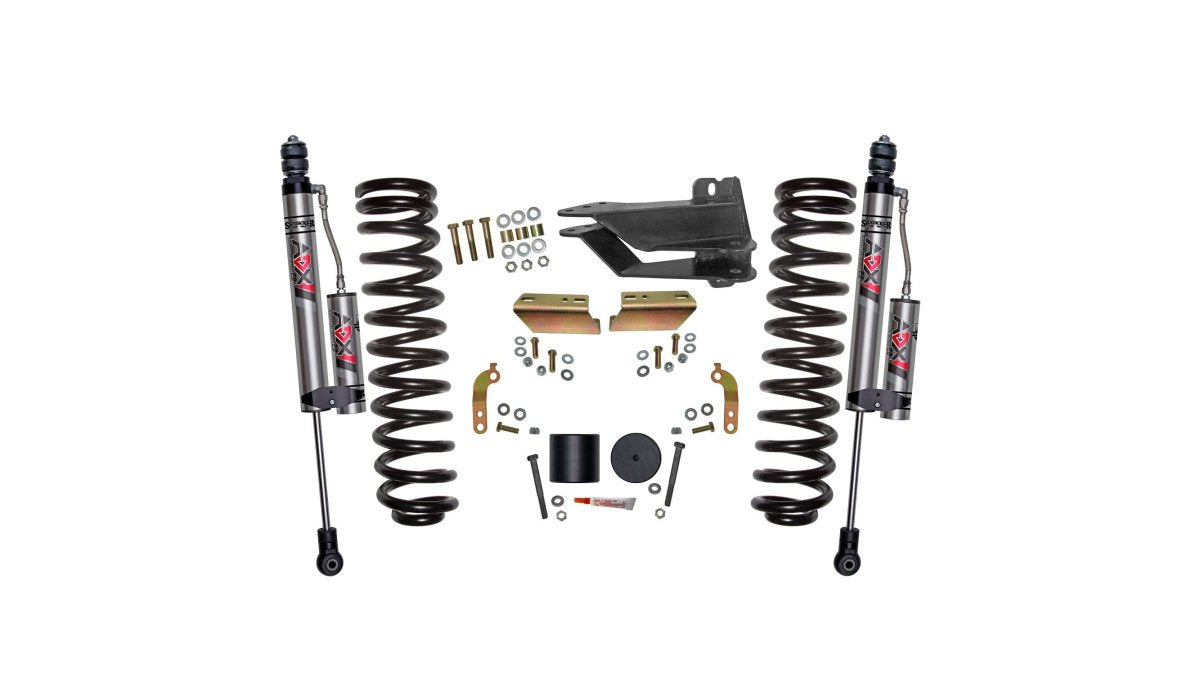
Skyjacker F1725VBKX 2.5-Inch Front Leveling Kit with ADX 2.0 Remote Reservoir →
- Application-specific spring rates, especially on diesel trucks with heavy front ends
- Track bar relocation bracketry that keeps the axle centered
- Sway bar and bump stop correction so the front end still works as designed
Skyjacker 2.5-Inch Kits for Ford Super Duty
For 2017-2021 Ford F-250 and F-350 Super Duty owners, Skyjacker offers several 2.5-inch front leveling options that differ mainly in how they handle damping.
The Skyjacker F1725MSB 2.5-Inch Front Leveling Kit uses cast ductile iron coil spacers and shock extension brackets to retain the factory shocks, which keeps the factory ride quality intact and leaves room to upgrade dampers later.
The Skyjacker F1725VBKB steps up to 2-Stage Dual Rate Softride coil springs and Black MAX nitrogen gas-charged twin-tube shocks with application-specific valving.

At the top of the range, the Skyjacker F1725VBKX adds ADX 2.0 remote reservoir shocks with race-inspired full-displaced valving and Advanced Foam-Cell technology.
Bilstein B8 5100 for Jeep Wrangler JL
For 2024-2026 Jeep Wrangler JL owners who want a true four-corner suspension upgrade, the Bilstein B8 5100 Lift Kit pairs four B8 5100 shocks with four custom-matched longer-travel cold-wound coil springs. It bolts into factory mounting locations and supports up to 35-inch tires on Rubicon models and up to 33-inch tires on non-Rubicon models with stock fenders, depending on wheel and tire specs.

Ground Clearance, Tire Fitment, and Off-Road Capability
Ground clearance and tire fitment are where a full suspension lift pulls ahead.
That extra articulation changes off-road capability. A leveling kit improves approach angle and stance; a suspension lift improves how the truck puts power down when one corner is loaded and another is hanging.
For most daily drivers, a leveling kit plus a sensible tire upgrade covers the occasional trail without hurting road manners. For regular trail use, the lift is the better tool.
How Lift Type Changes Ride Quality Off-Road
The more useful question is how each setup feels once the pavement ends, because that is where the differences get bigger.
- Spacer leveling kit: The factory springs and shocks still do the work, so the truck behaves much like stock on rough roads. The limitation is travel, the front suspension still has roughly the same range of motion, so big whoops and ledges can bottom out the front end. If the kit includes shock extensions, the ride stays close to stock; without them, sharp impacts feel harsher.
- Coil spring leveling kit: New front springs can carry trail weight better and keep the front end from diving, but the rear is still stock. On a loaded trail rig, the mismatch between front and rear can show up as a truck that feels planted up front and loose in the rear.
- Full suspension lift: Matched springs and shocks at all four corners give you the most control over how the truck behaves on rough terrain. Longer travel lets the suspension absorb obstacles instead of transmitting them to the cab, and quality damping keeps the truck from bouncing after a drop-off. This is where a well-sorted lift earns its cost.
Tire Fitment and Ride Quality
Tire size is part of the ride quality conversation. Taller sidewalls absorb bumps better than low-profile tires, which can soften the ride on rough pavement. But larger, heavier tires add unsprung weight, making the suspension work harder and dulling steering response if the damping is not up to it.

Fitment also varies by truck. A leveling kit that supports 33-inch tires on one configuration may not clear the same size on a different trim, engine, or wheel offset.
Approach, Departure, and Breakover Angles
A leveling kit mainly improves the front approach angle. A full suspension lift raises the whole chassis, improving approach, departure, and breakover angles together. For owners who regularly cross ditches, ledges, or steep trail obstacles, the full lift is the more complete solution; for mostly-pavement drivers who occasionally hit a graded dirt road, the leveling kit covers the need without the trade-offs.
Matching the Setup to the Use
A practical way to decide:
- Mostly pavement, occasional dirt road: a quality leveling kit with a sensible tire upgrade is enough, and it preserves the most factory ride character.
- Regular trail use, moderate obstacles: a matched full suspension lift in the 2.5- to 4-inch range with geometry correction is the better tool, and it can ride as well as or better than stock when the components are matched.
- Serious off-road use, large tires: a taller lift with quality damping and full geometry correction is the starting point, not the finish line. Expect to spend more on shocks and correction parts to keep ride quality acceptable.
Installation Quality and Post-Install Setup
Installation quality decides more of your ride quality than the kit label does. Two identical kits can feel completely different depending on whether the installer torqued everything to spec, centered the axle, and set the alignment correctly.
Post-install setup worth insisting on:
- Full alignment with a printed before-and-after sheet
- Track bar and axle centering verified
- All bracketry re-torqued after the first few hundred miles
Truck Army Tech Tip
Measure your front fender-to-ground height on level ground before and after any leveling or lift install, and write both numbers down.
Deciding between a leveling kit and a suspension lift comes down to how much ride change you will accept for the clearance you want.
Truck Army carries application-specific leveling kits and suspension systems built for your exact truck, with fitment details listed for each product so you can confirm compatibility before you order.
Frequently Asked Questions
Will a leveling kit affect ride quality?
A spacer leveling kit that reuses your factory shocks and coils generally keeps the ride close to stock because the springs and damping don't change, though a taller spacer can reduce available suspension travel. A coil spring leveling kit paired with matched shocks, like the Skyjacker 2.5-inch kits for 2017-2021 Ford F-250 and F-350 Super Duty, changes the spring rate and damping, so the ride can feel firmer or more controlled. What you feel depends on kit design, lift height, and tire choice more than the word 'leveling' on the box.
Is a suspension lift better than a leveling kit for ride quality?
Neither is universally better. A full suspension lift replaces springs and shocks together, so the ride is tuned as a system and taller lifts usually include geometry correction parts. A leveling kit costs less and keeps more of the factory feel when it reuses stock shocks. If you mostly drive on pavement and want a leveled stance, a leveling kit is the simpler answer. If you want more ground clearance and wheel travel for off-road use, a matched suspension lift typically delivers more capability.
Does a leveling kit affect handling or alignment?
Yes, both can change. Raising the front changes caster and camber slightly, and the steering feel can get lighter or wander if the kit doesn't address geometry. That's why alignment after a leveling kit matters, and why kits that include a track bar relocation bracket and sway bar lowering brackets help keep the axle centered and roll control intact. Get a professional alignment after installation and recheck torque on the new hardware after the first few hundred miles.
What should I consider before choosing a leveling kit or suspension lift?
Start with how you use the truck: daily driving, towing and payload, or off-road trails. Confirm the kit fits your exact year, make, model, and trim, since fitment varies by configuration. Decide whether you want to keep factory shocks or upgrade damping, and check what tire size the kit supports. Budget for installation and an alignment, and ask whether geometry correction parts like track bar brackets are included. A kit that matches your use case beats a taller kit that fights it.