

Quick answer
Match the jack to your trailer tongue first: A-frame jacks bolt to the top of a V-shaped (A-frame) tongue, swivel jacks mount to the side of a straight tongue and flip up for travel, and direct-weld square jacks with a drop leg suit heavy equipment trailers. Then pick a capacity above your loaded tongue weight and enough travel to lift the coupler clear of the hitch ball. Stabilizer jacks are a separate thing: they steady a parked camper and are not made for lifting it.
Trailer jack types at a glance
| Type | Mounts to | Typical use | Examples we carry |
|---|---|---|---|
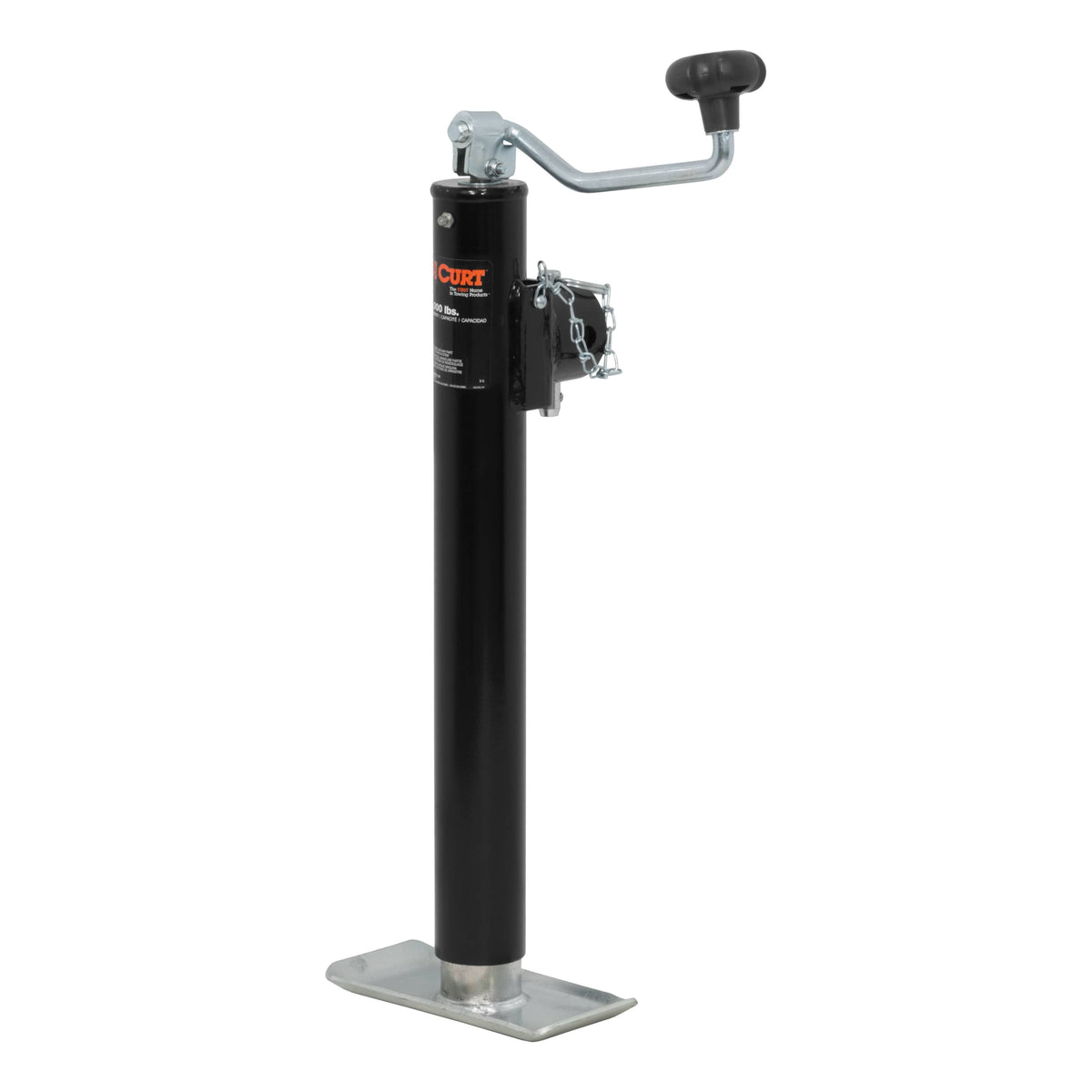
| A-frame (top-wind or side-wind) | Top of an A-frame tongue | Campers, travel trailers, larger utility trailers | Husky Towing manual A-frame jacks rated 1,000, 2,000 and 5,000 lb; CURT 28250 A-frame jack, 5,000 lb |
| Electric A-frame | Top of an A-frame tongue, wired to 12V | Heavy campers where cranking gets old | Husky Towing electric jacks rated 4,500 lb and 5,000 lb with 18 in. travel and a 6 in. drop-down leg |
| Swivel, pipe-mount | Side of a straight tongue (weld-on or bolt-on mount) | Boat, utility and landscape trailers | CURT pipe-mount swivel jacks rated 3,000 and 5,000 lb, including a side-wind version |
| Swivel, bracket-style | Weld-on bracket on the tongue | Utility and boat trailers | CURT weld-on bracket-style swivel jacks, 3,000 lb |
| Direct-weld square with drop leg | Welded to the tongue | Equipment, car hauler and heavy utility trailers | CURT 28570 and 28575, 8,000 lb support capacity |
| Stabilizer (scissor, telescopic, fifth wheel) | Frame or under the king pin | Steadying a parked camper or fifth wheel | Husky Towing scissor stabilizers, slide-out stabilizers and fifth wheel king pin stabilizers |
A-frame jacks
If your trailer tongue is shaped like a V, you need an A-frame jack. It bolts through a round hole in the top plate of the tongue, right behind the coupler. You'll see two styles:
- Top-wind: the crank handle is on top. Simple and common.
- Side-wind: the handle turns on the side through a gearbox, which is easier to reach when a propane tank or storage box sits on the tongue.
Electric A-frame jacks do the same job with a switch instead of a crank. They need a 12V supply, usually the camper's battery. The Husky Towing electric models we carry also have built-in LED lights and a 6-inch drop-down leg for extra reach.
Swivel jacks
Straight-tongue trailers (boat, utility and landscape trailers) usually use a swivel jack. It mounts to the side of the tongue. When you're ready to tow, you pull a pin and swing the jack up so it rides horizontal and clear of the road. Two mounting styles:
- Pipe-mount: the jack slides onto a round pipe mount that is welded or bolted to the tongue. CURT also sells replacement pipe mounts if yours is worn.
- Bracket-style: a flat bracket welds to the tongue and the jack pins to it.
Many swivel jacks can take a caster wheel so you can roll a light trailer around by hand on pavement. A foot plate is the better choice on gravel, grass or dirt.
Direct-weld square jacks (drop leg)
Heavy equipment trailers usually run a square-tube jack welded straight to the tongue. These have a drop leg: you pull a pin and let the inner leg drop to the ground, then crank the last few inches. That saves a lot of cranking on a tall trailer. The CURT 28570 and 28575 we carry are rated for 8,000 lb support capacity. Welding should be done by someone qualified to weld trailer structures.
Stabilizer jacks are not lifting jacks
Scissor jacks, telescopic stabilizers and fifth wheel king pin stabilizers keep a parked camper from rocking when people move around inside. They take some load off the suspension and landing gear, but they're not designed to lift the trailer or replace the tongue jack. Level the trailer first, then set the stabilizers.
How to size a trailer jack
- Find your loaded tongue weight. A common rule of thumb is 10 to 15 percent of the loaded trailer weight. A tongue weight scale gives the real number.
- Pick a jack rated above that number. Extra capacity makes cranking easier and is easier on the gears. Note that some jacks list a lift capacity and a higher support capacity; size to the lift rating.
- Check travel. Measure from the ground to the bottom of the coupler with the trailer level, then make sure the jack's travel can raise the coupler above your hitch ball height with room to spare.
- Match the mount. A-frame tongue, round pipe mount, weld-on bracket or square weld-on. Check bolt holes and tube diameter against the product listing.
Wheels, feet and parts
Small parts keep a jack working: caster wheels (CURT's 6-inch casters fit a 2-inch tube and are rated 1,200 lb), jack feet and foot pads, replacement handles, cranks, caps and pins. Wheel chocks belong in every trailer kit too, since a jack is not a parking brake.
What we carry
Shop all trailer jacks, including A-frame, swivel, electric and stabilizer jacks and parts from CURT and Husky Towing. Each listing shows capacity, travel and mount type. For the rest of the setup see trailer parts and wiring, fifth wheel and gooseneck hitches and all towing gear.
Related guides: 4-way vs 7-way trailer wiring, fifth wheel vs gooseneck hitch and trailer hitch classes explained.
Have a question? Contact us. More guides: Truck Buying Guides.
Frequently asked questions
What size trailer jack do I need?
Choose a jack with a lift rating above your trailer's loaded tongue weight, which is commonly 10 to 15 percent of the loaded trailer weight. Then check that its travel can raise the coupler above your hitch ball.
What is the difference between top-wind and side-wind jacks?
Top-wind jacks have the crank on top. Side-wind jacks turn from the side through a gearbox, which helps when a propane tank or box on the tongue blocks the top.
Can I lift my camper with stabilizer jacks?
No. Stabilizer jacks only steady a parked trailer. Use the tongue jack and leveling blocks to lift and level, then set the stabilizers.
Should I get a caster wheel or a foot plate?
A caster wheel lets you roll a light trailer by hand on hard surfaces. A foot plate spreads the load and works better on soft ground like gravel, dirt or grass.