

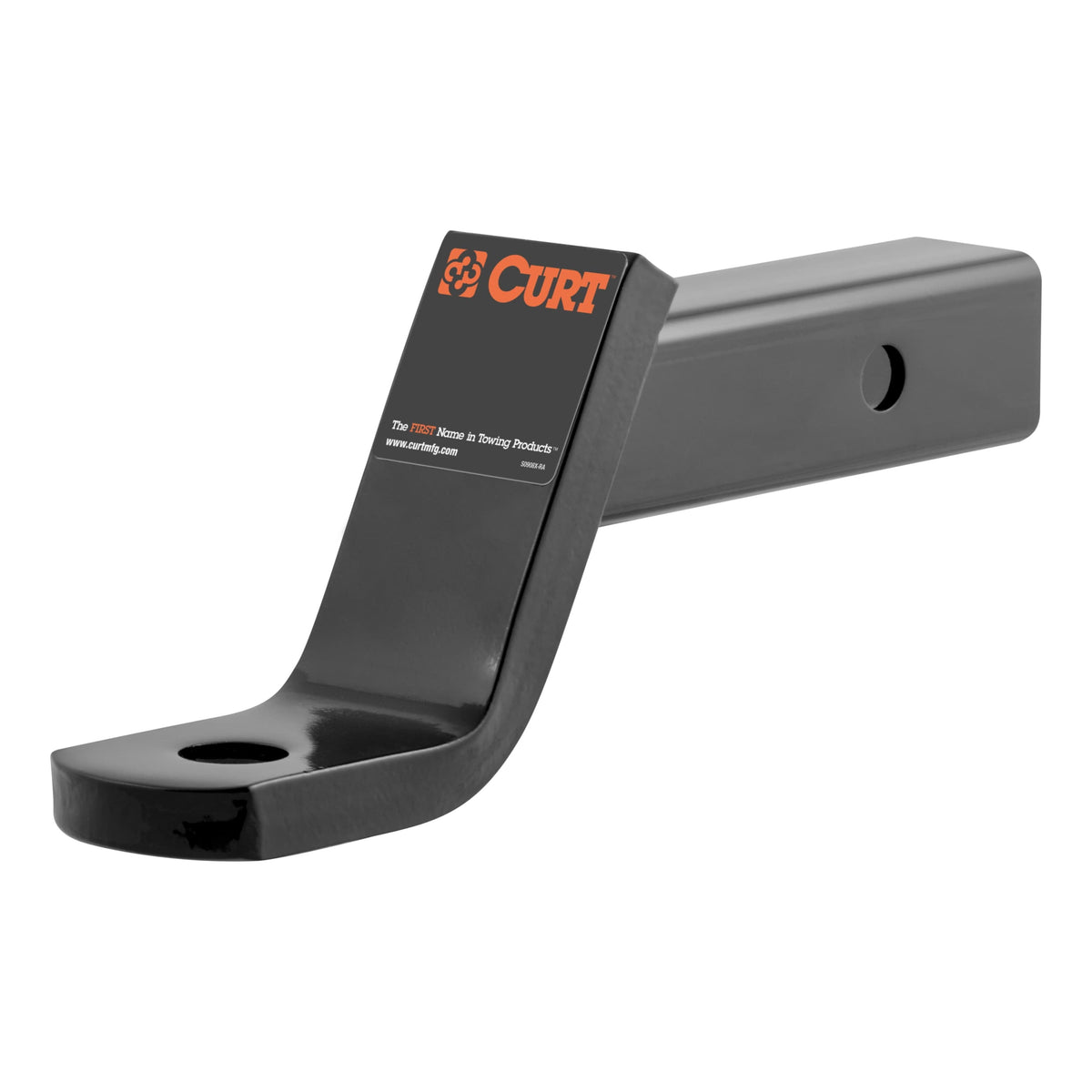
Quick answer
Park the truck and trailer on level ground with the trailer sitting level. Measure from the ground to the top of the inside of the receiver opening, then from the ground to the bottom of the trailer coupler. Subtract the coupler height from the receiver height: that's the drop you need. If the coupler is higher than the receiver, the difference is the rise. Then match the ball mount's shank to your receiver size, the hitch ball to the size stamped on your coupler, and keep every part rated for the trailer's weight.
The four things that decide your ball mount
| What to match | How to find it | Common sizes |
|---|---|---|
| Drop or rise | Receiver height minus coupler height (trailer level) | 2 in. to 9 in. drop is common; lifted trucks often need 6 in. or more |
| Shank size | Inside width of your hitch receiver opening | 1-1/4 in., 2 in., 2-1/2 in., 3 in. |
| Hitch ball size | Stamped on the trailer coupler | 1-7/8 in., 2 in., 2-5/16 in. |
| Ball hole (shank diameter) | Hole in the ball mount platform must match the hitch ball's threaded shank | 3/4 in., 1 in., 1-1/4 in. |
Why a level trailer matters
A trailer that rides nose-down puts extra weight on the hitch and less on the trailer axles. One that rides nose-up takes weight off the hitch, which can make the trailer more likely to sway. Either way the trailer's tires and brakes don't share the load the way they were designed to. The right drop or rise puts the coupler at the height the trailer was built to ride, so it tows flat.
How to measure for drop or rise
- Park on level ground. Load the truck the way you normally tow if you can.
- Level the trailer. Use the tongue jack until the trailer frame sits level front to back.
- Measure the receiver. Ground to the top of the inside of the receiver tube opening.
- Measure the coupler. Ground to the bottom of the coupler (where the ball sits).
- Subtract. Receiver height minus coupler height = drop. If the answer is negative, that number is the rise you need.
Example: the receiver is 21 inches off the ground and the coupler is 17 inches off the ground. 21 - 17 = 4, so you need a ball mount with about a 4-inch drop.
Remember that the rear of the truck settles when tongue weight goes on the hitch. If your number lands between two sizes, or you tow trailers of different heights, an adjustable ball mount lets you fine-tune it. Heavy trailers that make the truck squat a lot may also need a weight distribution hitch.
Can a drop ball mount be used as a rise?
Many fixed ball mounts can be flipped over to give a rise instead of a drop. Some listings show both numbers, like the CURT 45850 (4-inch drop, 2-inch rise) and CURT 45521 (3-1/4-inch drop, 2-5/8-inch rise). Not every mount is designed to be flipped, so check the listing before you do it.
Shank size: match your receiver
The shank is the square bar that slides into your hitch receiver. It must match the receiver opening:
- 1-1/4 in.: typical on Class 1 and 2 hitches for cars, crossovers and small SUVs.
- 2 in.: the most common size on pickups and full-size SUVs (Class 3 and 4).
- 2-1/2 in. and 3 in.: heavy-duty and commercial hitches (Class 5).
Not sure what you have? See our trailer hitch classes guide.
Hitch ball size and ball hole
The ball diameter must match the coupler. The size is stamped on the coupler, and a mismatch is never safe: a 2-inch ball in a 2-5/16-inch coupler can pop off. The ball's threaded shank must also match the hole in the ball mount (3/4, 1 or 1-1/4 inch). If the hole is larger than the ball shank, a reducer bushing can make up the difference; CURT makes bushings that reduce a 1-inch hole to 3/4 inch and a 1-1/4-inch hole to 1 inch.
Weight ratings: the lowest part wins
Your hitch, ball mount, hitch ball and pin each carry a weight rating, and so does your vehicle. The safe towing limit is the lowest of those ratings. A 7,500 lb ball mount on a 3,500 lb hitch is still a 3,500 lb setup. Check the vehicle owner's manual and the label on the hitch.
Fixed, adjustable or dual-ball?
- Fixed ball mounts are simple and strong. Good when you tow the same trailer every time. CURT makes them in many drops, from 2-inch up to 8-inch in the 2-inch receiver size we carry.
- Adjustable ball mounts let you move the ball platform up or down the shank. Good for more than one trailer or a truck that gets lifted later. Examples we carry: CURT 45901 (6-3/4-inch drop, 6,000 lb) and CURT 45903 slim adjustable (3-3/4-inch drop, 10,000 lb).
- Dual- and tri-ball mounts carry two or three ball sizes so you can hook up different couplers without swapping balls. Examples: CURT StowPro dual-ball mounts in 5, 7 and 9-inch drops for 2-inch and 2-1/2-inch receivers, and the CURT 45799 adjustable tri-ball mount (1-7/8, 2 and 2-5/16-inch balls).
- Cushioned mounts like the CURT Rebellion XD (6-inch drop, 2-inch receiver, 15,000 lb) add a cushion to soften the jolts between truck and trailer.
Lifted trucks
A lift or leveling kit raises the receiver, so most lifted trucks need a bigger drop than stock. Measure again after any lift, and look at 6, 7, 8 or 9-inch drop mounts. A long drop puts more leverage on the receiver, so stay within every part's rating.
What we carry
Shop ball mounts, hitch balls and pins and receiver hitches from CURT, plus locks, pins and ball covers. For the rest of your setup see weight distribution and sway control and all towing gear.
Related guides: trailer hitch classes explained, do I need a weight distribution hitch? and 4-way vs 7-way trailer wiring.
Have a question? Contact us. More guides: Truck Buying Guides.
Frequently asked questions
How do I know what drop I need for my ball mount?
With the trailer level, measure from the ground to the top of the inside of the receiver opening and from the ground to the bottom of the coupler. Subtract the coupler height from the receiver height. That number is the drop.
What happens if my trailer is not level?
Nose-down puts extra weight on the hitch; nose-up takes weight off the hitch and can make sway more likely. In both cases the trailer's axles, tires and brakes don't share the load as designed.
Can I flip a ball mount to get a rise?
Many fixed ball mounts can be flipped, and their listings show both a drop and a rise number. Check the product listing first, because not every mount is designed to be used upside down.
What size hitch ball do I need?
Use the ball size stamped on your trailer coupler, usually 1-7/8, 2 or 2-5/16 inches. The ball's weight rating must also meet or beat the trailer's weight.