

Quick answer
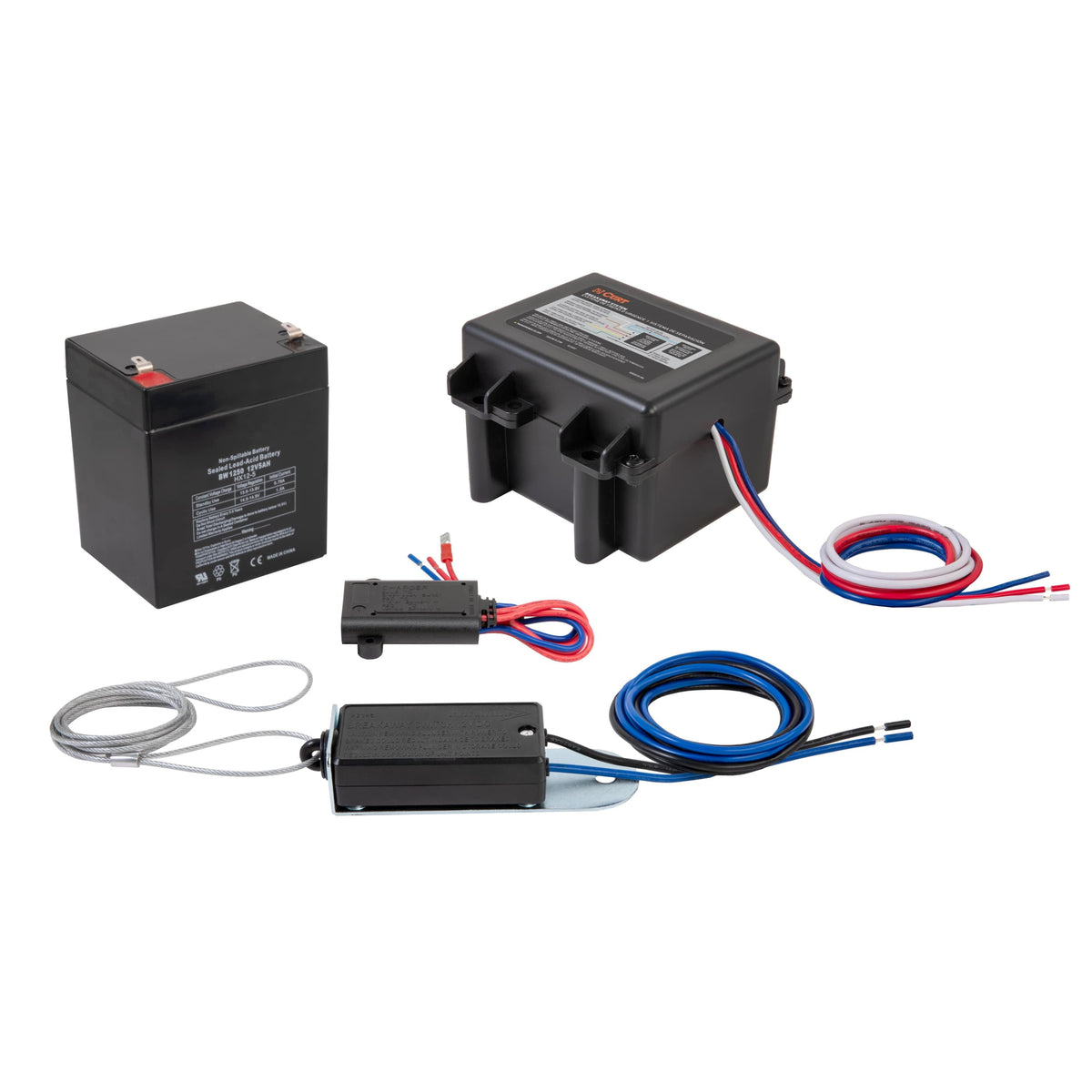
A trailer breakaway system is a 12-volt battery, a switch with a pull pin and a lanyard clipped to your tow vehicle. If the trailer separates from the hitch, the lanyard pulls the pin and the switch sends battery power straight to the trailer's electric brakes, stopping the runaway trailer. It works only on trailers with electric brakes. Test it before every trip and keep the battery charged.
How a breakaway system works
Your brake controller normally powers the trailer brakes through the 7-way connector. A breakaway system is a backup that doesn't depend on the tow vehicle at all:
- Battery: a sealed 12V battery rides on the trailer, usually in a case on the tongue.
- Switch: wired between the battery and the brake magnets. While the pin is in, the circuit is open.
- Lanyard: a cable from the pin to the tow vehicle. If the coupler, ball or ball mount fails and the trailer pulls away, the lanyard yanks the pin out.
- Brakes apply: with the pin out, the switch closes and the battery energizes the brake magnets at full power until the pin goes back in or the battery runs down.
DOT rules for commercial trailers require the breakaway brakes to stay applied for at least 15 minutes, which is why the battery has to be kept charged. The CURT kits we carry are listed as meeting DOT requirements for holding and breakaway situations.
Do I need a breakaway system?
If your trailer has electric brakes, you should have one, and in most states it's the law. Rules vary by state and are usually tied to trailer weight, so check your state's requirements for your trailer's gross weight. Trailers with surge brakes (common on boat trailers) use a mechanical breakaway cable on the surge actuator instead, so a battery kit isn't used there.
CURT breakaway kits compared
| Kit | What's in the box | Battery case | Best for |
|---|---|---|---|
| CURT 52040 Soft-Trac 1 | 12V 5-amp rechargeable battery, nylon breakaway switch with 48 in. lanyard, 12V charger | Lockable top-load plastic case with screw-tight lid and rubber gaskets | Owners who want the battery locked against tampering |
| CURT 52028 Soft-Trac 2 | 12V 5-amp battery, nylon switch with 48 in. lanyard, 12V charger | Top-load case with a metal bracket and 3-1/8 in. hole that mounts on the tongue or a jack post | Trailers with a round tongue jack where you want a clean mount |
| CURT 52026 Soft-Trac 2 | Battery, switch and Soft-Trac 2 case (no charger in the title) | Same jack-post style case | Trailers that already charge the battery another way |
| CURT 52044 Push-to-Test | 12V 5-amp battery, nylon switch, push-to-test case | Top-load case with LEDs that show good charge, charging or low battery at the push of a button | Anyone who wants a quick charge check before each trip |
| CURT 52042 Push-to-Test | Same as 52044 | Side-load push-to-test case, bolt-on mounting | Tongues where a side-load case fits better |
Replacement parts
- CURT 52023 breakaway battery: sealed lead-acid, 12V, listed for trailers with up to three axles.
- CURT 52025 breakaway battery charger: for CURT Soft-Trac 1 and Soft-Trac 2 batteries; the 52042 push-to-test kit also lists it for recharging.
- CURT 52010 breakaway switch with nylon pull pin and metal tab, and the CURT 52020 replacement lanyard.
- Battery cases: CURT 52027 watertight case (5 x 3-3/8 x 3-3/4 in.) and CURT 52022 lockable case (6 x 5-1/2 x 3-1/4 in.).
Flat-towing a car behind a motorhome? CURT also makes a 52210 breakaway system for RVibrake and a 52205 wireless breakaway adapter for RVibrake 3 and RVibrake 4 supplemental braking systems.
Where to attach the lanyard
- Clip it to a solid point on the tow vehicle, such as the hitch receiver's safety chain loop or frame, not to the ball mount or the trailer's safety chains. If the ball mount is what fails, a lanyard clipped to it goes along for the ride.
- Leave enough slack for tight turns so the pin doesn't pull while you're backing or turning, but not so much that the lanyard drags on the road.
- Route it so it can't snag on the coupler or the jack.
How to test a breakaway system
- Hook up the trailer and plug in the 7-way connector.
- Pull the pin out of the breakaway switch by hand.
- Try to pull ahead slowly at walking speed. You should feel the trailer brakes drag hard.
- Put the pin straight back in. Leaving it out drains the battery and keeps the brake magnets energized.
If the brakes don't grab, check the battery charge first, then the switch wiring and the brake magnets.
Keeping the battery charged
A breakaway battery slowly loses charge even when nothing is using it. Two ways to keep it ready:
- Charger on the trailer: the Soft-Trac 1 and Soft-Trac 2 kits include a 12V charger that is wired into the trailer so the battery tops up while you tow. This needs a working 12V auxiliary circuit on the tow vehicle's 7-way plug.
- Check before each trip: a push-to-test case shows the charge with LEDs. Otherwise use a voltmeter. Replace a battery that won't hold a charge.
What we carry
Breakaway kits and parts are in trailer parts and wiring, with batteries and chargers in batteries and chargers. See every CURT part and all towing gear.
Related guides: 4-way vs 7-way trailer wiring, trailer jack types explained and what size ball mount do I need.
Have a question? Contact us. More guides: Truck Buying Guides.
Frequently asked questions
What does a trailer breakaway switch do?
It connects the trailer's breakaway battery to the electric brakes when the pin is pulled. If the trailer separates from the tow vehicle, the lanyard pulls the pin and the brakes apply.
Does a breakaway kit work with surge brakes?
No. Battery breakaway kits are for trailers with electric brakes. Surge brake trailers use a mechanical breakaway cable on the actuator.
How do I test my trailer breakaway system?
With the trailer hooked up, pull the pin by hand and try to pull ahead slowly. The trailer brakes should drag hard. Put the pin back in right away.
Where should the breakaway lanyard attach?
To a solid point on the tow vehicle, such as the hitch's safety chain loop, not to the ball mount or the safety chains. Leave enough slack for turns without letting it drag.
How do I keep the breakaway battery charged?
Use a breakaway charger wired to the trailer so it charges from the tow vehicle while towing, and check the charge before each trip with a push-to-test case or a voltmeter.